

Lower Back Pain: Causes, Diagnosis, and Treatment
Lower Back Pain Causes, Diagnosis, and Treatment Almost...
Multispecialty Hospital in Padappai | Sayee Specialty Hospital
Heel Pain Every Morning This Is Probably Why - And It's More Common Than You Think
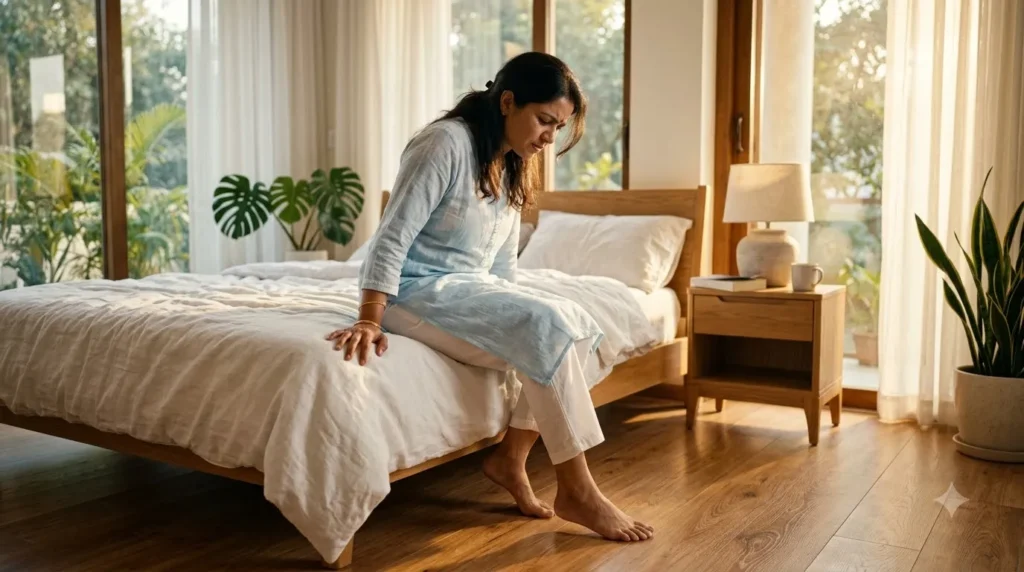
The first step out of bed in the morning is the worst one. The heel hits the floor and there’s a sharp, stabbing pain – sometimes described as stepping on a nail, sometimes as a burning sensation that shoots up from the bottom of the foot. It’s intense enough to make you pull back, sit on the edge of the bed, and carefully consider your next move.
After a few minutes of walking, it eases. Not completely, but enough to be manageable. By midday it might be barely noticeable. And then the next morning, the same thing happens again.
This pattern – sharp heel pain on first weight-bearing in the morning, gradual improvement with movement, and possible return after prolonged sitting – is one of the most recognisable presentations in orthopaedic practice. It has a name, a clear mechanical explanation, and a treatment pathway that works for the vast majority of people who follow it properly. The problem is that most people don’t follow any treatment pathway at all, because they don’t know what they’re dealing with.
The most common cause of this specific pattern of heel pain is plantar fasciitis – inflammation of the plantar fascia, a thick band of connective tissue that runs along the bottom of the foot from the heel bone to the base of the toes. The plantar fascia acts like a bowstring, supporting the arch of the foot and absorbing load during walking and running.
During sleep, the foot rests in a slightly pointed-down position (plantarflexion), and the plantar fascia shortens and tightens overnight. When you take that first step in the morning, the fascia is suddenly stretched from its contracted overnight position to the loaded walking position – and the area where it attaches to the heel bone, which is already inflamed, takes the brunt of that sudden stress. That’s the pain.
As you walk and the tissue warms up, micro-circulation improves, the fascia gradually loosens, and the pain reduces. But the underlying inflammation hasn’t resolved. Prolonged sitting during the day allows the fascia to tighten again, which is why many people experience a second episode of sharp pain when they stand up after sitting for an extended period – after lunch, after a long meeting, or getting out of the car.
Plantar fasciitis is not a rare condition. It affects roughly one in ten people at some point in their life and is the most common cause of heel pain in adults presenting to orthopaedic and physiotherapy clinics. It is not a condition reserved for athletes or elderly people – it shows up consistently in working-age adults whose occupations involve prolonged standing, in individuals who have recently changed their footwear or activity level, and in people who are carrying excess weight.
Plantar fasciitis is a load management problem. The fascia is taking more mechanical stress than it can absorb without inflammatory change, and the factors that determine that load versus capacity equation are predictable:
Both flat feet (pes planus) and high arches (pes cavus) alter how the plantar fascia handles load. In flat feet, the arch collapses during weight-bearing and the fascia is subjected to excessive stretch with each step. In high-arched feet, the fascia is permanently tighter and less able to absorb shock. Neither foot type is inevitably problematic, but both increase the risk of plantar fasciitis – particularly when combined with other load factors.
The calf muscles and Achilles tendon connect directly to the heel bone. When the calf muscles are tight – shortened from prolonged sitting, inadequate stretching, or sedentary habits – they pull the heel backward and upward, which increases tension in the plantar fascia. Calf tightness is one of the most consistent and most correctable risk factors for plantar fasciitis, and addressing it is central to most effective treatment programmes.
A simple test: standing facing a wall and placing the heel of one foot flat on the floor while trying to lean forward – if the heel lifts before you can achieve a 90-degree ankle angle, the calf is tight. Almost everyone with plantar fasciitis fails this test on the affected side.
Plantar fasciitis classically appears after a change in load – starting a new walking or running programme, returning to activity after a period of rest, beginning a job that requires prolonged standing after years of desk work, or simply walking significantly more than usual on a holiday or during a festival period. The fascia hasn’t had time to adapt to the increased demand, and inflammation develops at the point of highest stress – the heel attachment.
Thin-soled footwear, worn-out shoes, flip-flops, and flat chappals provide minimal arch support and cushioning. Walking on hard flooring – marble, tiles, concrete – in inadequate footwear is one of the most consistent aggravating factors reported by patients with plantar fasciitis in India. The issue is compounded by the cultural norm of walking barefoot at home, which removes any arch support entirely and often on hard floor surfaces.
The plantar fascia takes the equivalent of the entire body weight with each step – modified by speed, surface, and foot position. Excess body weight directly increases this load with every step taken. Weight gain is one of the more common triggers for plantar fasciitis in previously asymptomatic individuals, and weight management is a component of treatment for patients where it is relevant – not as a moral commentary but as a direct mechanical intervention.
Diabetic individuals have higher rates of plantar fasciitis and slower healing from it. Elevated blood glucose impairs collagen quality and microvascular supply to the fascia, reducing its load-bearing resilience and its ability to repair micro-damage between loading cycles. For diabetic patients with heel pain, the management approach is the same in principle but requires more careful monitoring and a longer treatment timeline.
Many patients arrive at an orthopaedic consultation with an X-ray showing a ‘heel spur’ – a bony projection on the underside of the heel bone – and a firm belief that this is the source of their pain. This is one of the most persistent misconceptions in foot health.
Calcaneal spurs (heel spurs) are bony growths that form at the attachment of the plantar fascia to the heel bone over time. They develop in response to repeated tensile stress at that attachment point. Here is the critical nuance: heel spurs are present in roughly half the population with plantar fasciitis – but they are also present in a significant proportion of people who have no heel pain at all. The spur itself is not the pain generator. The inflamed fascia surrounding it is.
This distinction matters because it changes the treatment approach. Targeting the spur surgically in isolation, without addressing the fascial inflammation and the mechanical factors driving it, does not reliably resolve the pain. The treatment for plantar fasciitis with or without a heel spur is essentially the same, and surgery on the spur itself is rarely the primary intervention recommended.
While plantar fasciitis is by far the most common explanation for the first-step morning pain pattern, a thorough orthopaedic assessment considers several other possibilities – particularly when the response to standard plantar fasciitis treatment is poor:
The Achilles tendon attaches at the back of the heel bone, and pain here is distinct from plantar fasciitis but sometimes confused with it. Achilles tendinopathy produces stiffness and pain at the back of the heel and lower leg on first movement in the morning, again easing with activity. It’s particularly common in runners and in people who have recently increased their walking or stair-climbing activity. The management shares some elements with plantar fasciitis treatment but differs in the loading protocol – specifically, eccentric calf exercises are the cornerstone of Achilles rehabilitation rather than simple calf stretching.
The heel pad – a specialised fat and connective tissue structure under the heel bone – provides the primary shock absorption for heel strike. With age and accumulated impact loading, this fat pad can thin and lose its cushioning capacity. The pain from fat pad atrophy is typically diffuse over the heel rather than focused at the front of the heel, and it’s particularly noticeable on hard surfaces. Cushioned insoles and appropriate footwear are the primary management, as the atrophy itself cannot be reversed.
Conditions like ankylosing spondylitis, psoriatic arthritis, and reactive arthritis can all cause enthesitis – inflammation at the point where a tendon or ligament attaches to bone. The plantar fascia insertion at the heel is a common enthesitis site. The distinguishing feature is that morning stiffness is prolonged (lasting more than 30 minutes), improves significantly with activity, and is often accompanied by other joint symptoms, lower back pain, or skin changes. This pattern warrants blood tests for inflammatory markers and rheumatological assessment, not just orthopaedic treatment for plantar fasciitis.
Plantar fasciitis resolves in the majority of patients within six to twelve months with consistent conservative management. The key word is consistent. The treatments that work do so because they reduce fascial tension, allow the inflamed tissue to heal, and address the mechanical factors that caused the problem in the first place. They require commitment over weeks and months rather than days.
Calf stretching and plantar fascia stretching are the two most evidence-supported interventions for plantar fasciitis. The plantar fascia stretch – done before taking the first step in the morning, while still seated at the edge of the bed – pre-lengthens the fascia before it’s suddenly loaded, which is the specific moment that causes the first-step pain. This single habit, done consistently, reduces morning pain significantly within two to four weeks in most patients.
The technique: sitting on the edge of the bed before standing, cross the affected foot over the opposite knee, grasp the toes and pull them back toward the shin until a stretch is felt along the arch and bottom of the foot. Hold for 30 seconds. Repeat three times. Then stand.
Shoes with adequate arch support, cushioned midsoles, and a slight heel raise reduce the load on the plantar fascia during weight-bearing. Off-the-shelf arch support insoles are appropriate for most patients and significantly improve pain during the recovery period. Avoiding barefoot walking on hard floors – keeping supportive footwear accessible beside the bed to put on immediately upon waking – is one of the highest-impact lifestyle changes a patient can make.
A night splint holds the foot in a dorsiflexed position (toes pulled toward the shin) during sleep, keeping the plantar fascia gently lengthened overnight rather than allowing it to contract. This directly addresses the mechanism of first-step pain and is one of the most effective single interventions for patients with severe morning pain. Compliance is the challenge – they’re not comfortable to sleep in initially – but patients who persist with them consistently report significant reduction in morning pain within two to four weeks.
A physiotherapy programme for plantar fasciitis goes beyond stretching to address all the contributing mechanical factors: calf tightness, intrinsic foot muscle weakness, hip and core stability deficits that affect foot loading patterns, and gait analysis where relevant. For patients who haven’t responded to stretching and footwear changes after four to six weeks, a formal physiotherapy assessment adds significant value.
A corticosteroid injection into the plantar fascia insertion provides significant pain relief in patients with moderate to severe symptoms who haven’t responded adequately to four to six weeks of conservative management. The injection reduces inflammation at the attachment point and allows the patient to engage more comfortably with the stretching programme. It is not a cure on its own – if the mechanical factors aren’t addressed, the inflammation returns. Used alongside the stretching and footwear programme, it accelerates recovery meaningfully.
For chronic plantar fasciitis that hasn’t responded to three to six months of conservative treatment, shockwave therapy – which delivers high-energy sound waves to the affected tissue to stimulate healing – has good evidence for effectiveness. It’s a non-surgical option that has shown significant pain reduction and functional improvement in patients with recalcitrant symptoms.
The majority of plantar fasciitis cases – around 90 percent – resolve with consistent conservative management within twelve months. The minority that don’t respond after this period, or that have a structural or inflammatory cause requiring a different approach, are the ones who benefit from specialist orthopaedic assessment.
Surgical options for truly recalcitrant plantar fasciitis include plantar fascia release, which partially releases the tight fascial band to reduce tension at the attachment. It is a last-resort procedure, not a first-line option, and is only considered after a documented conservative treatment failure of at least six to twelve months. The results are generally good, but the procedure carries risks of arch weakness and altered foot biomechanics that need to be part of the discussion.
Any of the following suggests that a specialist orthopaedic assessment is appropriate rather than continued self-management:
Sayee Specialty Hospital’s Orthopaedics department provides specialist consultations for heel pain, plantar fasciitis, foot and ankle conditions, and all musculoskeletal concerns – with in-house imaging facilities for accurate diagnosis. Whether your heel pain has been there for months and you’ve been managing it yourself, or you’re not sure what’s causing it and want a proper assessment, an orthopaedic consultation is the starting point for a treatment plan that actually moves things forward.
That first-step pain in the morning isn’t something you just have to live with. Most people who get the right diagnosis and follow through with treatment consistently find it resolves. The key is starting.
Book an orthopaedic consultation at Sayee Specialty Hospital, or call us at 9 976 976 976. Serving Padappai, Vandalur, Chromepet, Urapakkam, and South Chennai.
Recent Posts
Lower Back Pain Causes, Diagnosis, and Treatment Almost...

Strep Throat: Symptoms, Diagnosis, and Treatment Sore throats...
Understanding Menorrhagia: Causes, Diagnosis, and Treatment Most women...
Your Posture Is Destroying Your Spine Before 40...