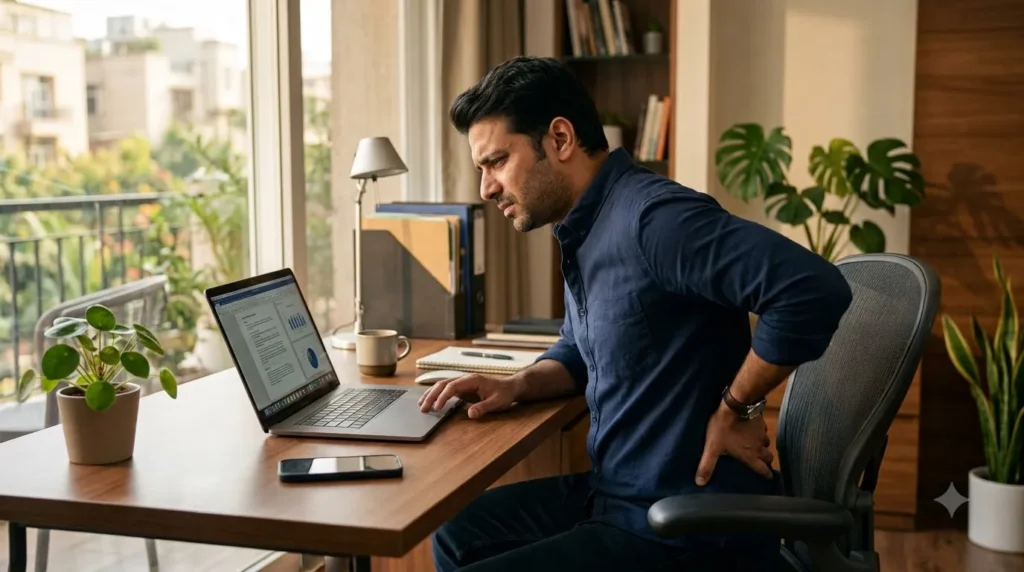
Most people know their posture isn’t great – a parent, a trainer, someone points it out, they straighten up for a moment, and gradually return to the position they’ve carried for years. The problem with that cycle is that posture-related spine damage isn’t reversible by straightening up in the moment. It accumulates in structures loaded unevenly, stretched beyond range, or compressed when they should have space. Orthopaedic clinics are now routinely seeing people in their late twenties and thirties with spinal imaging that looks significantly older than their age – disc degeneration, facet joint changes – alongside eight-plus hours of seated work and several more hours of phone use daily.
What Modern Sitting Does to the Spine
The spine has four natural curves that work together as a mechanical system, distributing load efficiently. Typical desk posture – shoulders rounded, head forward, lower back flattened – disrupts all of them at once: the lumbar curve flattens, shifting disc loading forward; the thoracic curve exaggerates; and the head migrates forward of its neutral position, which causes the most cumulative damage due to the mechanical multiplier effect of head weight on the cervical spine.
The Damage Patterns an Ortho Surgeon Actually Sees
Cervical Disc Degeneration from Forward Head Posture
The head weighs roughly 5 to 6 kilograms in neutral position. At just 5 centimetres of forward displacement – a typical smartphone posture – the effective cervical load increases dramatically. Sustained, this accelerates disc wear and facet joint arthritis, producing ‘tech neck’ in patients as young as their early thirties: chronic stiffness, base-of-skull headaches, and in advanced cases, arm tingling from nerve involvement.
Thoracic Kyphosis and Lumbar Disc Loading
Years of rounded-shoulder sitting cause the thoracic spine to structurally adapt, becoming stiff and resistant to extension – a pattern previous generations rarely showed before their seventies. In the lower back, a flattened lumbar curve shifts disc loading forward, placing tension on the posterior disc fibres; over years these can weaken and tear, the pathway to herniation and sciatica. Lumbar disc degeneration is now routinely found on MRI in patients in their early thirties.
Symptoms People Don’t Connect to Posture
- Tension headaches starting at the base of the skull – cervicogenic headaches from upper cervical joint irritation
- Mid-upper back aching after prolonged sitting
- Morning lower back stiffness taking 15–20 minutes to ease
- Shoulder pain with no specific injury, from altered scapular position
- Arm tingling after prolonged phone or laptop use
- Late-afternoon neck and upper back fatigue from sustained muscular effort
Exercises That Actually Address the Imbalance
General gym exercise doesn’t reliably fix desk-posture damage unless it targets the right muscles specifically:
- Chin tucks – activates deep cervical flexors, the single most effective exercise for reducing forward head posture
- Thoracic extension over a rolled towel – restores mobility to a spine held in sustained flexion
- Hip flexor stretching – corrects the anterior pelvic tilt driving lumbar overload
- Glute bridges – rebuilds the pelvic stability that prolonged sitting weakens
- Scapular retraction – pulls rounded shoulders back to a correct resting position
When It Needs More Than Exercise
- Radiating arm or leg pain alongside neck or back pain
- No improvement after six to eight weeks of consistent exercise and physiotherapy
- Progressive worsening despite lifestyle changes
- Weakness in the arms or legs alongside spinal symptoms
- Age under 35 with symptoms disproportionately severe for a postural cause – warrants imaging
Orthopaedic and Spine Consultations at Sayee Specialty Hospital, Padappai
Sayee Specialty Hospital’s Orthopaedics department provides specialist consultations for posture-related spinal pain, disc problems, and all musculoskeletal concerns, with in-house digital X-ray and CT for accurate diagnosis. Your spine carries everything you do, every day – the earlier it gets the right support, the longer it does that job without complaint.
Book an orthopaedic consultation at Sayee Specialty Hospital, or call us at 9 976 976 976. Serving Padappai, Vandalur, Chromepet, Urapakkam, and South Chennai.