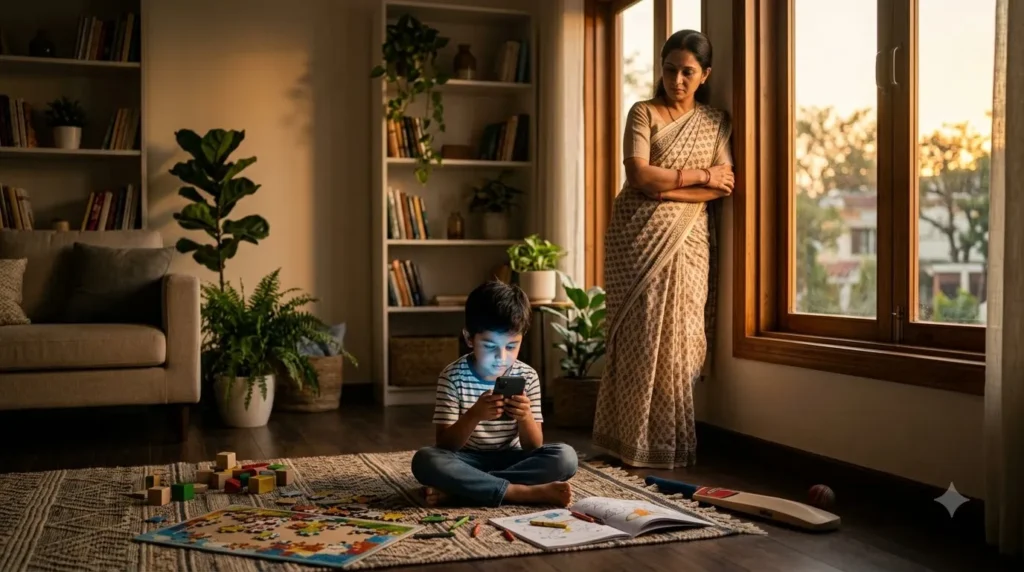
The parent mentions it almost as an aside – the child has been watching a lot of YouTube lately, or screens are the only way to get them to sit still for meals, or bedtime has become a negotiation over tablet minutes. What paediatricians are actually worried about in 2025 isn’t that children are using screens. It’s the specific ways certain screen use, at certain ages, displaces the developmental processes those years are built for – and that distinction is far more useful than any blanket hour limit.
What the Research Actually Shows
Sleep – The Clearest Finding
Screen use in the hour before bed delays sleep onset and reduces sleep quality, across every age group studied. Blue light suppresses melatonin, and stimulating content keeps the nervous system aroused when it should be winding down. Screen-free bedrooms and a cutoff 60 to 90 minutes before sleep are among the most evidence-backed – and most ignored – recommendations in paediatric sleep medicine.
Language Development
For children under two, screens don’t teach language the way human interaction does – young children learn through contingent, back-and-forth exchange that a screen cannot provide. Background television measurably reduces how much adults speak to a young child in the room, even when the adult isn’t consciously distracted. For children over two, co-viewing with an engaged adult changes the picture; passive solo viewing does not.
Attention and Myopia
Fast-paced, reward-optimised content sets an expectation for constant novelty that makes slower classroom instruction comparatively hard to sustain – this isn’t ADHD, but it looks like it. Separately, screen use combines two myopia risk factors at once: sustained near-work and reduced time outdoors, which is the single most protective factor against myopia progression identified in research.
The Newer Concern – Social Media in Adolescents
For older children and teens, social media platforms built around social comparison and intermittent validation are producing measurable mental health effects, particularly in adolescent girls – rising rates of anxiety, depression, and body image concerns tracking alongside adoption rates. Cyberbullying, unlike its in-person predecessor, is continuous and inescapable. Paediatricians now take a social media history as standard practice when assessing adolescent mood, sleep, or school withdrawal.
What Actually Helps, by Age
- Under 18 months: avoid screens except video calls, which are genuinely interactive rather than passive
- 18 months to 3 years: co-view high-quality content with active engagement; keep background TV off entirely
- 3 to 8 years: protect sleep, physical activity, and face-to-face time first – screen time fits around what’s left, not the other way round
- School-age and teens: screen-free bedrooms, a defined evening cutoff, and delaying social media access as long as practically feasible
- All ages: at least 60 to 90 minutes of outdoor time daily as a non-negotiable, and screen-free mealtimes
When to See a Paediatrician
- Distress at screens being removed that seems disproportionate and affects family functioning
- Sleep onset consistently past 10 or 11pm in a primary school-age child
- A toddler with speech delay alongside high screen time
- Teacher-reported inattentiveness that’s new or worsening
- An adolescent withdrawing socially with mood or sleep changes alongside heavy social media use
Paediatric Consultations at Sayee Specialty Hospital, Padappai
Sayee Specialty Hospital’s Paediatrics department provides developmental assessment, sleep and behaviour evaluation, and full paediatric consultations. If screen habits at home have you unsure whether you’re seeing normal childhood or something worth a closer look, a paediatric consultation gives you a clear answer.
Book a paediatric consultation at Sayee Specialty Hospital, or call us at 9 976 976 976. Serving Padappai, Vandalur, Chromepet, Urapakkam, and South Chennai.