


Lower Back Pain: Causes, Diagnosis, and Treatment
Lower Back Pain Causes, Diagnosis, and Treatment Almost...
Multispecialty Hospital in Padappai | Sayee Specialty Hospital
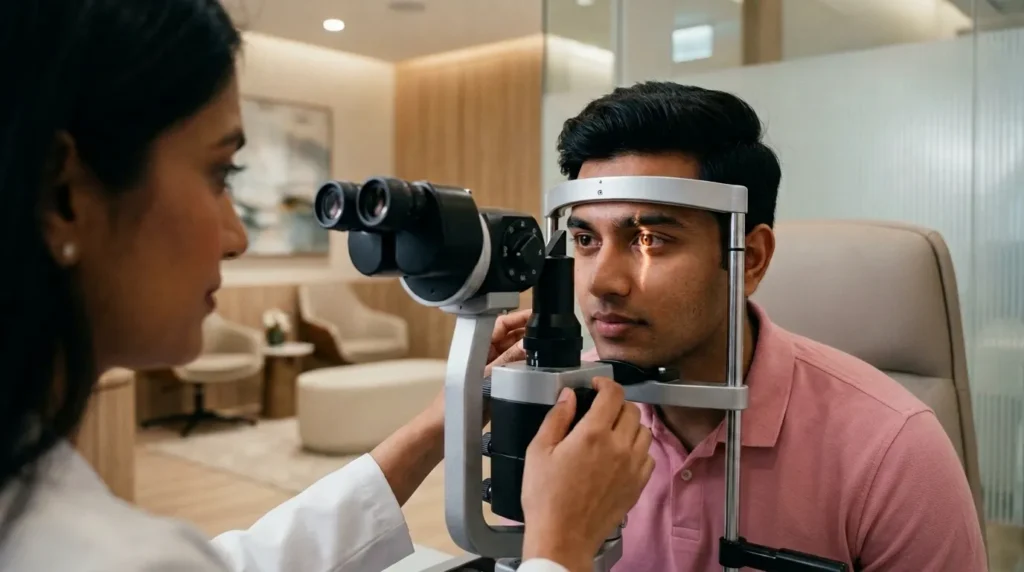
Cataract at 35? Why Young People Are Now Walking Into Eye Hospitals
Cataract carries a specific image in most people’s minds. An elderly person, squinting in bright light, moving carefully through a room because the world has gone soft and foggy around the edges. It is, by almost universal assumption, a condition that belongs to the last chapter of life.
Which is why it catches people off guard when they’re 34, or 38, or 41 – and an ophthalmologist tells them their lens is clouding. Not severely, not urgently, but enough to explain why night driving has become stressful, why bright lights now come with halos, why reading in dim light has quietly stopped being something they do.
Early-onset cataract – cataract developing before the age of 50 – is not a new phenomenon. But it is more common than it used to be, and the reasons why track closely with changes in how younger adults in India live, what conditions they carry, and what their eyes are exposed to across decades of daily life.
Understanding this is useful not just for people who already have symptoms, but for anyone in their thirties or forties who has never considered their lens health as something worth thinking about. Because by the time cataract is obvious, it has typically been developing quietly for years.
The lens of the eye sits just behind the pupil. Its job is to focus light precisely onto the retina at the back of the eye, adjusting its shape for different distances the way a camera lens does. For this to work, the lens needs to be transparent – completely clear, allowing light to pass through without scattering.
A cataract is what happens when proteins within the lens begin to clump together and lose their ordered arrangement. Instead of a clear medium, the lens becomes progressively cloudier – like looking through a fogged-up window that can’t be wiped clean from the outside. Light that enters the eye scatters rather than focusing cleanly, producing blurred or hazy vision, increased sensitivity to glare, and in some cases, a yellowing or browning of the visual field.
The process is gradual in most cases. A developing cataract in a young person might sit at a level where it’s detectable on examination but doesn’t significantly affect daily function for years. That window – between the cataract forming and it becoming functionally limiting – is exactly when understanding the cause and monitoring progression is most valuable.
Age-related cataract develops because of the cumulative effects of oxidative stress on the lens proteins over decades. In older adults, this is simply a long process reaching its natural conclusion. In younger adults, something is accelerating that process – or initiating a different type of lens clouding altogether. The reasons fall into several distinct categories:
This is the most common medical cause of early cataract in India by a significant margin. High blood glucose over extended periods alters the biochemistry of the lens – specifically, glucose accumulates inside the lens and is converted to sorbitol, which draws water in and disrupts the lens proteins. Diabetic cataracts can develop in patients in their thirties and forties, particularly those whose blood sugar has been poorly controlled for several years.
India has one of the highest burdens of diabetes in the world, and a significant proportion of that burden involves people who have had the disease for years before diagnosis – meaning their lenses have been under glycaemic stress without their knowledge. For any diabetic patient, regular eye examinations are not optional. They are part of managing the disease.
Corticosteroids – used for conditions ranging from asthma and skin disorders to autoimmune diseases and joint problems – are well-established cataract risk factors when used systemically over extended periods. The association is particularly strong with oral steroids, but prolonged use of high-potency topical steroids and nasal steroid sprays also carries a risk, particularly in genetically susceptible individuals.
The lens changes induced by steroids tend to occur in the posterior subcapsular region – a specific location that disproportionately affects reading vision and causes significant glare even when the cataract is not yet dense. People using steroids long-term for chronic conditions often don’t connect their worsening reading vision or glare sensitivity to their medication.
Ultraviolet radiation – particularly UV-B – induces oxidative damage to the lens proteins. Cumulative, unprotected sun exposure over years is a measurable risk factor for cataract development. This is particularly relevant in a country like India, where outdoor UV intensity is high across most of the year and sunglasses with genuine UV protection are inconsistently used.
Sunglasses that are purely cosmetic – tinted but without UV-400 certification – can actually be worse than no sunglasses at all, because the tint causes the pupil to dilate, allowing more UV-laden light to reach the lens. Genuine UV protection requires lenses rated UV-400, which block wavelengths up to 400 nanometres.
A direct blow to the eye, a penetrating injury, or even a significant contusion can disrupt the lens capsule and initiate cataract formation. Traumatic cataracts can develop rapidly – within days or weeks of injury – or slowly over years, depending on the nature and severity of the trauma. Sports injuries, accidents, and industrial eye injuries are the most common causes in this category, and many people who sustained eye injuries in their teens or twenties don’t connect them to a cataract appearing a decade later.
Hypothyroidism, hyperparathyroidism, atopic dermatitis, and certain genetic conditions are all associated with early lens changes. Nutritional deficiencies – particularly of antioxidant vitamins C and E – may accelerate oxidative lens damage. Heavy, chronic alcohol consumption and smoking are also independent risk factors, with smoking in particular associated with a two-to-threefold increased cataract risk across multiple large studies.
A family history of early cataract is a genuine risk factor. If a parent or sibling developed cataract before age 55, the likelihood of similar early onset is higher. This doesn’t mean it’s inevitable – but it does mean that routine eye examinations starting from the mid-thirties are a reasonable precaution rather than an overreaction.
Early cataract in a young person doesn’t look like advanced cataract in an elderly one. The symptoms are subtler and highly compatible with other, more obvious explanations:
Most people in their thirties presenting with these symptoms get new glasses. The glasses help for a while. Then the symptoms shift again. The pattern of prescription instability alongside glare sensitivity is a reasonably clear signal that the lens itself deserves a look, not just the refraction.
There are no eye drops, supplements, or medications that have been definitively proven to reverse or significantly halt cataract progression in humans. Research into this continues, but the current clinical position is that once cataract formation begins, the primary management tool is monitoring and, when appropriate, surgery.
What the evidence does support is protection and risk reduction for those who haven’t yet developed significant lens changes:
When a cataract progresses to the point where it’s affecting daily function – work, driving, reading – surgery is the only effective treatment. Cataract surgery replaces the clouded natural lens with a clear artificial intraocular lens (IOL). It is one of the most commonly performed and most successful surgical procedures globally.
In younger patients, a few considerations are specific to their age. The choice of IOL matters more – a young person choosing their artificial lens is potentially living with that lens for fifty or sixty years, which affects the decision around monofocal versus premium multifocal or extended depth-of-focus lenses. The refractive target needs to account for the possibility of natural refractive changes continuing into middle age.
Recovery is typically faster in younger patients, and outcomes are excellent when surgery is performed at an appropriately equipped facility with an experienced surgeon. The hesitation many young people feel – ‘am I too young for cataract surgery?’ – is understandable but often delays intervention beyond the point where it’s comfortable to wait.
The decision to operate is based on functional impact, not age. When the cataract is limiting what a person can do – not what an age chart says they should have by now – it’s time.
Sayee Specialty Hospital’s Ophthalmology department provides comprehensive eye examinations for adults of all ages – including assessment of lens health, cataract staging, refractive evaluation, and specialist consultations for patients with diabetes, steroid use history, or a family background of early eye disease.
If you’re in your thirties or forties and have noticed changes in your vision that don’t seem fully explained by your current glasses, or if you’re a diabetic who hasn’t had a recent eye examination, this is a reasonable point to get a proper look. Catching a developing cataract early doesn’t mean rushing to surgery – it means knowing what’s there and monitoring it properly.
Book an ophthalmology consultation at Sayee Specialty Hospital, or call us at 9 976 976 976 to schedule your appointment.
Recent Posts
Lower Back Pain Causes, Diagnosis, and Treatment Almost...

Strep Throat: Symptoms, Diagnosis, and Treatment Sore throats...

Understanding Menorrhagia: Causes, Diagnosis, and Treatment Most women...

Your Posture Is Destroying Your Spine Before 40...