


Lower Back Pain: Causes, Diagnosis, and Treatment
Lower Back Pain Causes, Diagnosis, and Treatment Almost...
Multispecialty Hospital in Padappai | Sayee Specialty Hospital
Sitting All Day Is Breaking Your Spine - An Ortho Doctor Explains
There is a version of this that sounds like an exaggeration. Sitting, after all, is something humans have done forever. Chairs exist for a reason. How bad can it really be?
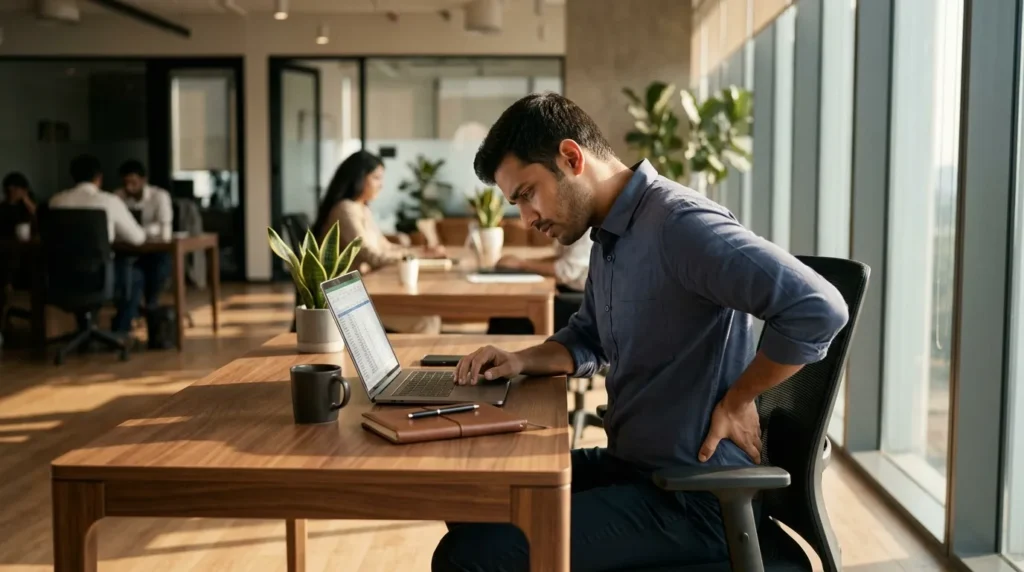
Here’s what the orthopaedic clinic actually sees: a 32-year-old software developer with disc herniation at two levels. A 28-year-old with chronic cervical spondylosis that’s causing radiating arm pain. People in their late twenties with the spinal imaging of someone a generation older. And in almost every case, the common thread is the same – eight to ten hours a day seated, for years, in positions their spine was never designed to sustain.
The human spine was built for movement. Not for prolonged static loading in a flexed position with a screen at eye level and both feet barely touching the floor. And when you hold it in that position for most of your waking hours – day after day, year after year – it accumulates damage that doesn’t announce itself loudly until something finally crosses a threshold.
By that point, the conversation has shifted from prevention to management. This post is about having it earlier.
The lumbar spine – the lower back – has a natural inward curve called the lordosis. This curve distributes the load of the upper body efficiently across the vertebrae and discs. When you sit in a typical chair, particularly one without proper lumbar support, this curve flattens or reverses. The load shifts forward onto the front edges of the intervertebral discs rather than being distributed evenly.
Studies measuring intradiscal pressure have found that sitting with a forward lean – the posture most people unconsciously adopt when working at a desk or looking at a phone – generates significantly higher pressure on the lumbar discs than standing upright or even walking. You are loading your discs more intensely by sitting badly than you would be by being on your feet.
Over time, that sustained uneven loading has several consequences:
Intervertebral discs are the shock-absorbing pads between each vertebra. They don’t have a direct blood supply in adults – they get their nutrition through the movement of fluid, which happens when you load and unload them through activity. Prolonged static sitting starves the discs of this nutrient exchange while simultaneously loading them unevenly.
The result, over years, is accelerated disc degeneration – the disc loses height and hydration and becomes less able to absorb load. A degenerated disc is more vulnerable to herniation – where the soft inner material pushes through the outer wall and presses on nearby nerve roots. This is when back pain stops being a dull ache and starts radiating down the leg. That radiation pattern is sciatica, and it is far more common in desk workers than most people expect.
For every inch the head moves forward of its neutral position, the effective load on the cervical spine roughly doubles. At the neutral position, the head weighs around 5 to 6 kilograms. At 5 centimetres of forward lean – a typical phone-use posture – the cervical spine is managing the equivalent of significantly more. Hours of this, daily, accelerates wear on the cervical discs and facet joints.
Cervical spondylosis – degenerative changes in the neck vertebrae – used to be primarily a condition of people in their fifties and beyond. It’s now consistently presenting in people in their late twenties and thirties, with symptoms ranging from chronic neck stiffness and headaches to numbness and tingling in the fingers from nerve root compression.
Prolonged sitting tightens the hip flexors – the muscles at the front of the hip that keep the leg lifted. When these muscles are chronically shortened, they pull the pelvis into an anterior tilt, which exaggerates the lumbar curve and compresses the lower back joints. Simultaneously, the glutes – the primary stabilisers of the pelvis – become weak and underactivated from spending hours compressed under body weight.
The outcome is a spine that’s being asked to do stability work it wasn’t designed for, because the surrounding muscles that should be sharing that load have become unreliable. This is the biomechanical foundation of most chronic lower back pain in desk workers, and it’s why back pain that starts as a workplace issue follows people to the gym, the park, and eventually to bed.
The spine rarely gives you one dramatic warning sign. It tends to build a case incrementally:
These symptoms are easy to manage temporarily with painkillers and ignore otherwise. The risk of doing so is that the underlying structural problem – disc degeneration, nerve compression, muscle imbalance – quietly progresses while the symptom gets suppressed.
Exercise helps. It genuinely does – people who are physically active outside work hours have significantly lower rates of back pain than those who are sedentary across the board. But there’s a flaw in the logic of offsetting eight hours of poor seated posture with a one-hour gym session.
Research on sedentary behaviour and health outcomes consistently shows that the effects of prolonged sitting are not fully reversed by exercise performed at other times of day. The metabolic and mechanical consequences of long unbroken periods of sitting are somewhat independent of total physical activity. An hour of exercise after eight hours of sitting is better than no exercise – but it doesn’t cancel out the eight hours.
What actually makes a difference, alongside regular movement, is breaking up sitting time. A 2-minute walk or standing break every 30 to 45 minutes is enough to restore disc nutrition exchange, reset muscle activation patterns, and substantially reduce cumulative spinal load over the course of a day. The barrier to this is almost entirely awareness and habit – not time.
This isn’t a list of things that require purchasing expensive equipment or redesigning your workspace from scratch. These are the adjustments that consistently make a measurable difference:
The top of the monitor should be at or slightly below eye level. Looking down at a laptop screen for hours is one of the fastest ways to accelerate cervical degeneration. A laptop stand or external monitor, combined with an external keyboard, costs very little and changes the cervical load profile significantly.
Most office chairs have a lumbar support that either doesn’t reach the right level or is set too far back to make contact with the spine when the person is sitting forward. The lumbar support should sit at the small of the back – roughly the belt line – and maintain contact. A rolled towel or a purpose-built lumbar roll is sometimes more effective than the chair’s built-in support.
Sitting with the hips slightly higher than the knees – rather than the flat 90-degree position most chairs produce – allows the lumbar curve to maintain more of its natural shape. A seat wedge or slightly raising the chair height achieves this without any structural change to the workspace.
Set a timer. Every 30 minutes, stand up, walk to another room, do 10 to 15 seconds of gentle extension – hands on the lower back, lean back slightly – and then return. This is not about fitness. It’s about interrupting the sustained mechanical loading on the discs and resetting the muscle activation that prolonged sitting switches off.
Core work for spine health isn’t crunches. Crunches actually load the lumbar disc in the same direction that sitting does. The exercises that protect the spine are those that build stability without spinal flexion – planks, bird-dogs, dead bugs, and hip bridges. These are movements a physiotherapist would specifically target, and they address the glute weakness and hip flexor tightness that desk work creates.
The majority of back pain related to sitting and posture responds well to physiotherapy, targeted exercise, and ergonomic changes – particularly when addressed early. But there are situations where an orthopaedic consultation is the right next step rather than a self-management approach:
For anyone in South Chennai looking for an orthopaedic specialist, getting a proper spinal assessment – including imaging where indicated – is what separates a diagnosis from a guess. Many people spend months managing the wrong problem because the underlying cause was never properly identified.
Sayee Specialty Hospital’s Orthopaedics department provides consultations for back pain, neck pain, disc problems, sciatica, and all spine-related conditions – supported by in-house digital X-ray and CT scan facilities for accurate diagnosis. Whether you’re dealing with a long-standing ache that’s getting progressively worse or a new symptom that’s starting to affect your daily function, a specialist assessment is the fastest route to an answer that actually helps.
Your spine has been carrying the load of your work life quietly. It’s worth finding out how it’s actually doing.
Book an orthopaedic consultation at Sayee Specialty Hospital, or call us at 9 976 976 976 to schedule your visit.
Recent Posts
Lower Back Pain Causes, Diagnosis, and Treatment Almost...

Strep Throat: Symptoms, Diagnosis, and Treatment Sore throats...

Understanding Menorrhagia: Causes, Diagnosis, and Treatment Most women...

Your Posture Is Destroying Your Spine Before 40...