


Lower Back Pain: Causes, Diagnosis, and Treatment
Lower Back Pain Causes, Diagnosis, and Treatment Almost...
Multispecialty Hospital in Padappai | Sayee Specialty Hospital
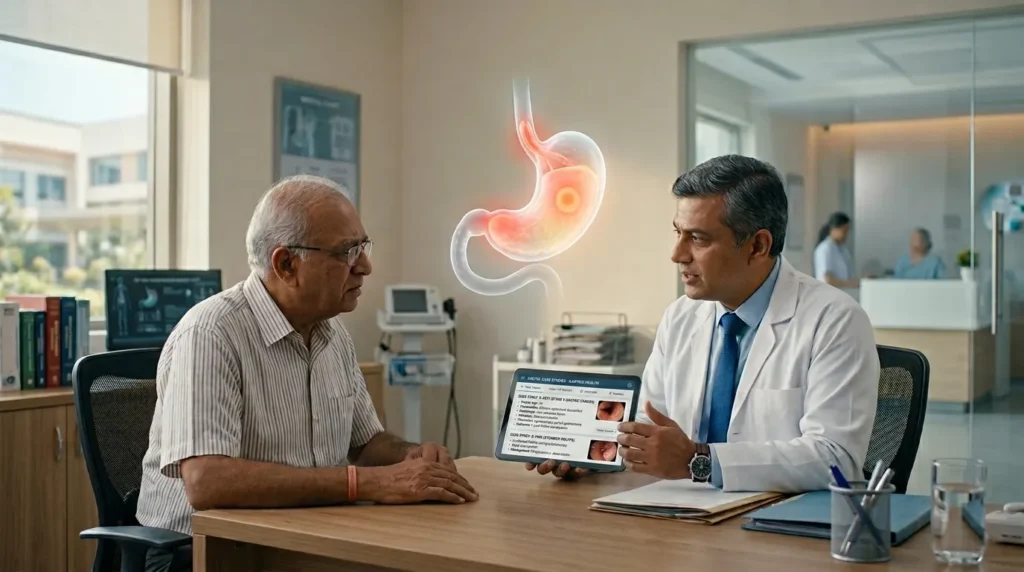
Acidity Every Single Day? Your Gut Is Trying to Tell You Something Serious
There’s a particular kind of person who reaches for antacids the way most people reach for their morning coffee – automatically, without thinking twice. The burn after lunch, the bloating by evening, the sour taste that greets them before they’ve even brushed their teeth. It’s just how things are.
Except it isn’t how things are supposed to be. Daily acidity is not a personality trait or a consequence of ‘eating spicy food’. It’s a pattern that, when left untreated for long enough, has a documented path toward complications that go well beyond discomfort.
If you’re reaching for an antacid more days than not, your gut has been trying to get your attention for a while. Here’s what it might actually be saying.
Stomach acid is supposed to stay in the stomach. A muscular valve called the lower esophageal sphincter (LES) sits at the junction between the oesophagus and stomach, and its job is to keep that acid from travelling upward. When this valve weakens or relaxes at the wrong time, acid escapes into the oesophagus – which has no protective lining – and you feel it as burning, sourness, or pressure in the chest and throat.
A single episode of this is completely normal. A heavy meal, lying down too soon after eating, a particularly stressful week – these can all trigger occasional reflux. The body handles it and moves on.
The problem starts when it’s happening every day, or nearly every day. At that point, the oesophageal lining is being exposed to acid repeatedly, and repeated exposure causes damage that accumulates over time.
Gastroesophageal reflux disease – GERD – is the clinical diagnosis when acid reflux becomes a chronic, recurring condition rather than an occasional inconvenience. It’s one of the most common gastrointestinal diagnoses in India, and one of the most undertreated.
GERD doesn’t always look like dramatic heartburn. The symptom picture is broader than most people realise:
The cough and hoarseness are particularly easy to misattribute. Many people treat these as respiratory problems for months before a gastroenterologist identifies reflux as the underlying cause.
Chronic acidity is a symptom, not a diagnosis in itself. And it can point toward several different underlying conditions, some of which are more serious than others.
Helicobacter pylori is a bacterial infection that affects the stomach lining and is far more common in India than most people realise. It disrupts the stomach’s natural acid-regulating mechanisms and, over time, leads to gastritis and peptic ulcers. Many people carry H. pylori for years without obvious symptoms – daily bloating, mild nausea, and persistent acidity are often the only signs. It’s diagnosed with a simple breath test or stool antigen test and treated with a defined course of antibiotics.
Peptic Ulcers which is acid repeatedly damages the stomach lining or the lining of the upper small intestine, ulcers form. The classic symptom is a burning or gnawing pain in the upper abdomen, often occurring on an empty stomach and temporarily relieved by eating. People frequently mistake this for hunger-related acidity and treat it with antacids for months without addressing the ulcer itself.
A hiatal hernia occurs when part of the stomach pushes upward through the diaphragm into the chest cavity. It weakens the lower esophageal sphincter and makes acid reflux significantly more likely. Many people have a small hiatal hernia without ever knowing it, but larger ones cause persistent, difficult-to-control GERD that doesn’t respond well to standard antacids or even prescription medications.
Barrett’s Esophagus is the complication people least expect to hear about from what started as ‘just acidity’. Barrett’s oesophagus is a condition where chronic acid exposure causes the normal lining of the lower oesophagus to change into tissue resembling the intestinal lining. It’s a direct consequence of long-term untreated GERD, and while it doesn’t always progress further, it does carry a small but measurable increased risk of oesophageal cancer. Regular monitoring through endoscopy is the standard approach once it’s been identified.
Not all chronic stomach discomfort traces back to acid. Functional dyspepsia – persistent upper abdominal discomfort, bloating, and early satiety without a clear structural cause – is increasingly recognised as a gut-brain axis disorder. Stress, anxiety, and sleep disruption all directly affect gut motility and acid secretion. The stomach is more neurologically connected to the brain than most organs, which is why stress reliably makes acidity worse.
Antacids neutralise stomach acid temporarily. They work quickly, which is exactly why they’re so easy to rely on. But they don’t address why the acid is escaping the stomach in the first place, and they don’t protect the oesophageal lining from ongoing damage.
Long-term, heavy reliance on antacids – particularly calcium carbonate types – can actually rebound, triggering increased acid production once the dose wears off. Proton pump inhibitors (PPIs) like omeprazole are more effective for GERD management but also come with considerations when used for extended periods without medical supervision.
The point isn’t that these medications are harmful. The point is that managing the symptom without diagnosing the cause means whatever is actually happening in your gut continues unchecked.
Several common habits significantly worsen acid reflux, and many people don’t connect them to their symptoms:
Adjusting these factors helps. For a mild case, it may help considerably. But if symptoms have been daily for months or years, lifestyle changes alone typically aren’t enough to reverse existing damage or treat an underlying structural or bacterial cause.
These are the signs that self-management has reached its limit and a gastroenterology consultation is overdue:
An endoscopy is the most direct way to assess what’s actually happening inside the oesophagus and stomach – it’s a quick, outpatient procedure that answers questions no symptom checklist can. For anyone in Padappai or South Chennai dealing with long-standing digestive symptoms, having access to a gastroenterologist with in-house endoscopy facilities means getting a real diagnosis rather than continuing to guess.
Sayee Specialty Hospital’s Gastroenterology department offers consultations for chronic acidity, GERD, bloating, ulcers, and all digestive health concerns – with in-house diagnostic support including endoscopy for cases that need a closer look. Whether you’ve been living with daily acidity for months or you’ve noticed symptoms that are starting to worry you, a proper evaluation is the only way to know what you’re actually dealing with.
Reaching for the antacid tin one more time isn’t an answer. Getting it properly looked at is.
Book a gastroenterology consultation at Sayee Specialty Hospital, Padappai, or call us at 9 976 976 976. We’re here seven days a week.
Recent Posts
Lower Back Pain Causes, Diagnosis, and Treatment Almost...

Strep Throat: Symptoms, Diagnosis, and Treatment Sore throats...

Understanding Menorrhagia: Causes, Diagnosis, and Treatment Most women...

Your Posture Is Destroying Your Spine Before 40...