


Lower Back Pain: Causes, Diagnosis, and Treatment
Lower Back Pain Causes, Diagnosis, and Treatment Almost...
Multispecialty Hospital in Padappai | Sayee Specialty Hospital
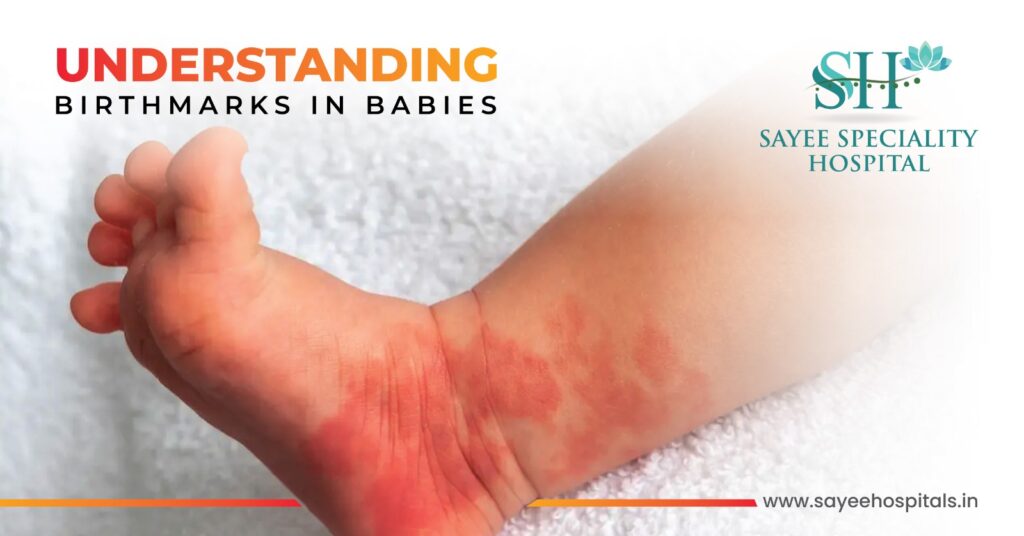
Understanding Birthmarks in Babies
The first thing most parents do after a baby is born is look them over counting fingers, checking toes, taking in every detail of this new person. And sometimes, in that first examination, something unexpected appears. A reddish patch on the forehead. A bluish mark on the lower back. A raised strawberry-coloured lump that wasn’t there at the two-week check but has appeared by six weeks.
Birthmarks are extraordinarily common more than one in ten babies is born with some type, and many more develop one in the first weeks of life. The vast majority are completely harmless. But knowing what you’re looking at, understanding which ones need watching, and recognising the small number of signs that warrant a doctor’s opinion that’s genuinely useful knowledge for any new parent to have.
Birthmarks broadly fall into two types depending on what’s causing them, and that distinction matters because the two categories behave quite differently and have different implications for monitoring and treatment.
Vascular birthmarks arise from abnormal blood vessels near the surface of the skin. Because blood vessels give them their colour, they tend to appear red, pink, or purple. Pigmented birthmarks arise from an excess of melanin, the pigment that determines skin colour concentrated in a particular area. These tend to appear brown, grey, or black.
Within those two broad categories, the specific types have distinct characteristics, timelines, and considerations.
Salmon patches are the most common birthmark of all, appearing in roughly half of all newborns. They go by the affectionate names “stork bites” when on the back of the neck and “angel kisses” when on the forehead or eyelids flat, pink or red patches that become more visible when the baby cries or gets warm. On the face, they almost always fade and disappear within the first couple of years. Stork bites on the nape of the neck can sometimes persist into adulthood, but they’re typically covered by hair and cause no problems whatsoever. No treatment needed, no monitoring required.
Infantile haemangiomas commonly called strawberry marks are a different matter, though still reassuring in the majority of cases. They don’t usually appear at birth but develop in the first few weeks of life, growing rapidly through the first year before entering a slow, gradual phase of involution. By age five, around half have significantly faded. By age ten, most have resolved substantially. They appear as bright red, raised, soft lesions on the skin surface, though deeper haemangiomas develop beneath the skin and appear more bluish or skin-coloured with a slight swelling.
Most haemangiomas require nothing more than observation and reassurance. The exceptions and they’re important are haemangiomas in specific locations or of significant size. A haemangioma near the eye can interfere with vision development if it’s large enough to obstruct the visual field. Haemangiomas around the mouth or nose can affect feeding or breathing. Large haemangiomas over the beard distribution of the face can occasionally be associated with internal haemangiomas affecting the airway. These warrant early specialist assessment and, where indicated, treatment typically with oral propranolol, a beta-blocker that has transformed the management of problematic infantile haemangiomas over the last fifteen years.
Port-wine stains are flat, red or purple marks present from birth that don’t fade in fact they tend to darken and thicken over time if untreated. They’re caused by a localised malformation of capillaries in the skin and occur in roughly 0.3% of births. Unlike salmon patches and haemangiomas, they’re permanent without intervention. Port-wine stains affecting the face particularly around the eye and forehead — require medical evaluation because of an association with Sturge-Weber syndrome, a rare condition involving similar vascular malformations affecting the eye and brain. Pulsed dye laser treatment is the standard management approach and is most effective when started early.
Café-au-lait spots are smooth, flat patches of light brown pigmentation their name comes from the French for “coffee with milk,” which describes their colour well. They’re common, appearing in a significant proportion of children, and most are entirely benign. The clinical relevance comes with numbers, a single café-au-lait spot is almost always harmless. Six or more spots, particularly if they’re larger than a certain diameter, raise the possibility of neurofibromatosis type 1, a genetic condition that warrants investigation. A paediatric assessment for a child with multiple café-au-lait spots is appropriate.
Dermal melanocytosis previously and less appropriately called Mongolian spots are flat, bluish-grey patches most commonly found on the lower back and buttocks, though they can appear elsewhere on the body. They occur when melanocytes, the pigment-producing cells, become trapped deeper in the skin during development. They’re particularly common in babies of Asian, African, Hispanic, and Middle Eastern heritage. They’re entirely benign and typically fade during early childhood without any intervention. The main clinical relevance is making sure they’re documented clearly at birth their bruise-like appearance has occasionally led to unnecessary safeguarding concerns when a healthcare professional unfamiliar with the mark encounters it later.
Congenital melanocytic naevi are moles present at birth they can range from a few millimetres to, in rare cases, very large lesions covering significant areas of the body. Small and medium congenital naevi are common and generally low risk, though they warrant periodic monitoring for changes in appearance. Large and giant congenital naevi those covering a substantial surface area carry a small but elevated lifetime risk of melanoma and require specialist dermatological follow-up. Hair growing from a naevus is normal and doesn’t in itself indicate anything concerning.
Most birthmarks need nothing more than a note in the baby’s records and periodic observation. But there are specific circumstances where a medical opinion shouldn’t wait.
Any birthmark that grows rapidly — particularly in the first weeks of life deserves assessment to confirm it’s a haemangioma behaving normally rather than something requiring earlier intervention. Bleeding from a birthmark, persistent pain or tenderness, or ulceration of the surface are signs that the lesion needs review. A change in colour or texture in a pigmented mark darkening, irregular borders developing, new satellite spots appearing nearby warrants dermatological assessment.
Location matters independently of behaviour. Birthmarks near the eyes, nose, or mouth get assessed earlier because of the potential for functional impact. Multiple birthmarks appearing in clusters, or numbers of café-au-lait spots beyond what would be considered incidental, prompt a broader evaluation.
If something about a birthmark feels wrong to you as a parent it’s changed, it looks different, your gut is telling you to get it checked trust that instinct and make the appointment. Paediatricians and dermatologists would always rather reassure a parent than have a lesion that warranted attention go unreviewed.
The majority of birthmarks require no treatment at all either they resolve spontaneously or they remain stable and harmless indefinitely.
When treatment is indicated, the options depend on the type and location of the birthmark. Pulsed dye laser therapy is the primary treatment for port-wine stains and can also address residual or persistent haemangiomas. For infantile haemangiomas requiring intervention, oral propranolol is now the first-line treatment, it works by causing the blood vessels feeding the haemangioma to constrict, slowing growth and accelerating involution. Topical timolol, a beta-blocker in gel form, is sometimes used for smaller, superficial haemangiomas. Surgical removal is considered in specific cases for large congenital naevi, for lesions that haven’t responded to other treatment, or where the residual appearance after natural involution is significant enough to warrant correction.
Early evaluation means early decisions and for the conditions where timing of treatment matters, like port-wine stains where laser is more effective on younger skin, getting the assessment done promptly makes a real difference to outcomes.
A birthmark is, for the vast majority of babies, simply a feature part of what makes them who they are physically, with no implications for their health. Understanding what type it is, knowing what normal evolution looks like for that type, and being clear about the specific signs that would prompt a reassessment is all most parents need.
For the small number of birthmarks that do need monitoring or treatment, modern paediatric dermatology offers genuinely effective options and outcomes are consistently better when assessment happens early rather than late.
Recent Posts
Lower Back Pain Causes, Diagnosis, and Treatment Almost...

Strep Throat: Symptoms, Diagnosis, and Treatment Sore throats...

Understanding Menorrhagia: Causes, Diagnosis, and Treatment Most women...

Your Posture Is Destroying Your Spine Before 40...