


Lower Back Pain: Causes, Diagnosis, and Treatment
Lower Back Pain Causes, Diagnosis, and Treatment Almost...
Multispecialty Hospital in Padappai | Sayee Specialty Hospital
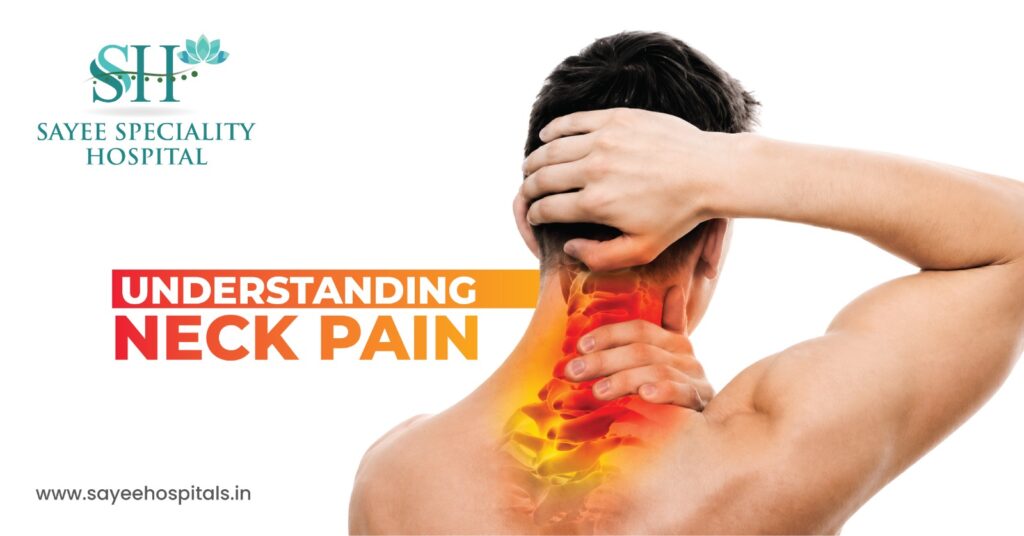
Understanding Neck Pain
Neck pain has become one of those things that affects almost everyone at some point and increasingly, it’s affecting people younger than it used to. The combination of desk work, smartphones, and the kind of sustained sedentary posture that modern life demands has created a generation of people who know exactly what it feels like to reach the end of a workday with a neck that feels like concrete.
Most of the time it resolves. But understanding why it’s happening, what’s actually going on in the cervical spine, and when it crosses the line from something manageable at home to something worth getting properly assessed, that knowledge makes a real difference.
The cervical spine is a remarkable piece of engineering seven vertebrae supporting the full weight of the head, allowing rotation, flexion, and extension across a wide range, while simultaneously protecting the spinal cord and the nerve roots branching out to the arms. That combination of mobility and load-bearing makes it inherently vulnerable to both acute injury and cumulative strain.
Poor posture is the most common driver in the modern context, and it’s worth understanding the mechanism rather than just accepting it as a vague explanation. When the head sits in a neutral position directly above the shoulders, the cervical spine bears roughly the weight of the head around 4 to 5 kilograms. As the head moves forward, which is what happens when you hunch over a laptop or look down at a phone the effective load on the cervical spine increases dramatically with each degree of forward tilt. At 45 degrees of forward head posture, the cervical spine is managing the equivalent of around 22 kilograms. Sustain that position for hours daily, and the muscles, ligaments, and discs at the base of the neck accumulate strain far faster than they can recover.
Physical strain from repetitive movement, heavy lifting with poor mechanics, or sleeping in a position that leaves the neck unsupported for hours creates muscular tightness and, over time, joint irritation. Whiplash the rapid forced flexion-extension movement that occurs in rear-end collisions can damage muscles, ligaments, and facet joints in ways that sometimes produce symptoms for months after the initial injury.
Age-related changes contribute increasingly from the fourth decade onward. Cervical spondylosis degenerative changes to the discs and vertebral joints, is almost universal in people over 60 on imaging, though it causes symptomatic pain in a smaller proportion. Disc herniation, where the soft inner material of a disc pushes through the outer layer and compresses an adjacent nerve root, produces the characteristic radiating pain, tingling, and weakness that can track down the arm in a dermatomal pattern. Spinal stenosis narrowing of the spinal canal itself, is a more advanced degenerative change that can compress the spinal cord as well as the nerve roots.
Emotional stress deserves mention as a genuine physiological contributor rather than a psychological catch-all. The trapezius and other cervical muscles are among the first to tighten under sustained psychological stress, it’s an involuntary protective response, and people often carry significant muscular tension in the neck and shoulders for days or weeks during stressful periods without consciously registering it until the pain becomes noticeable.
Neck pain itself varies considerably in character from a dull, persistent ache localised to the posterior neck, to a sharp, catching pain with specific movements, to a burning discomfort that builds through the day. Stiffness and reduced range of motion particularly difficulty rotating the head fully in one or both directions are common accompanying features.
Where the picture becomes more clinically significant is when symptoms extend beyond the neck itself. Headaches originating at the base of the skull and spreading forward cervicogenic headache are a consistent feature of upper cervical dysfunction. Shoulder and upper back pain often accompany cervical muscle tightness, as the connected muscle groups react to the same underlying strain.
Tingling, numbness, or shooting pain radiating down into one or both arms particularly if it follows a specific pathway toward certain fingers indicates nerve root involvement. This is cervical radiculopathy, and it warrants proper assessment rather than home management alone. Weakness in the hand or arm muscles alongside the sensory symptoms adds further urgency to getting that assessment done.
For most straightforward neck pain without neurological features, the diagnosis is clinical history, examination of range of motion, palpation of the cervical muscles and joints, and assessment of whether any neurological signs are present.
Imaging is reserved for specific indications. X-rays identify bony changes degenerative changes, loss of disc height, facet joint arthritis, and in post-trauma cases, fractures. MRI provides the detailed soft tissue picture disc morphology, nerve root compression, cord involvement, and inflammatory changes that X-ray misses entirely. CT scanning offers superior bony detail and is particularly useful in acute trauma assessment. Blood tests are relevant when inflammatory or infectious causes are suspected raised inflammatory markers pointing toward conditions like rheumatoid arthritis or ankylosing spondylitis affecting the cervical spine.
The important clinical flag is the combination of neck pain with upper limb neurological symptoms that combination consistently warrants imaging to characterise what’s compressing the nerve before a rehabilitation plan is designed.
For the majority of acute and subacute neck pain without neurological involvement, conservative management is effective and should be the starting point.
Staying active matters more than most people expect. The instinct when the neck is painful is to rest and protect it, but prolonged immobility worsens muscular deconditioning and stiffness, and the evidence consistently supports gentle continued movement over rest. That doesn’t mean pushing through severe pain, but it does mean not treating the neck like it needs to be splinted.
Physical therapy is the most evidence-based intervention for both acute and chronic neck pain. A physiotherapist assesses the specific pattern of dysfunction whether it’s primarily muscular, joint-related, or postural and designs a programme accordingly. Manual therapy targeting cervical joint mobility, combined with a progressive exercise programme building deep cervical flexor strength and addressing postural habits, produces better outcomes than either passive treatment or exercise alone. That deep cervical flexor strengthening component is particularly important, these small muscles at the front of the neck are the stabilisers of the cervical spine and are consistently found to be weak and poorly coordinated in people with chronic neck pain.
Pain management during the acute phase uses NSAIDs and paracetamol to reduce inflammation and allow movement. Muscle relaxants are occasionally used short-term for significant spasm. Topical anti-inflammatory preparations applied directly to the neck can provide localised relief with minimal systemic effects.
Heat and cold therapy serve different purposes. Heat, a warm pack, a hot shower directed at the neck and shoulders, a heated wheat bag relaxes muscular tension and improves blood flow to the area, making it most useful for chronic tightness and stiffness. Cold an ice pack wrapped in a towel reduces acute inflammation and is most appropriate in the first 48 hours after an acute injury or flare.
Stress management isn’t a soft add-on for people whose neck pain has a significant tension-driven component, addressing the physiological stress response directly is as important as addressing the physical mechanics. Mindfulness, diaphragmatic breathing, yoga, and progressive muscle relaxation all reduce baseline muscular tension in ways that translate to reduced neck pain.
Ergonomic and lifestyle adjustments prevent recurrence more effectively than any treatment. Screen height at eye level rather than below, a chair that supports lumbar curvature and allows the head to sit over the shoulders, a supportive pillow that maintains cervical alignment during sleep, regular movement breaks during sustained desk work these aren’t complicated interventions, but consistently applied they change the daily mechanical load on the cervical spine fundamentally.
Most neck pain resolves within a few weeks with appropriate conservative management. The situations that warrant prompt medical review rather than watchful waiting are worth knowing clearly.
Neck pain following a trauma a fall, a collision, any significant impact should be assessed before assuming it’s just muscular. Neck pain accompanied by arm weakness, significant sensory disturbance, or any difficulty with coordination or balance warrants imaging without delay. Neck pain severe enough to prevent sleep, or that’s been present and unchanged for more than six weeks without improvement, deserves investigation. Neck pain with fever, unexplained weight loss, or a history of cancer requires urgent evaluation to exclude serious underlying pathology.
And if neck pain is accompanied by any symptoms suggesting spinal cord involvement difficulty walking, changes in bladder or bowel function, a heavy or clumsy feeling in the legs that’s an emergency presentation, not a GP appointment.
For the overwhelming majority of people with neck pain, the prognosis is good. Acute episodes resolve. Chronic pain improves with the right combination of physiotherapy, lifestyle adjustment, and where necessary, targeted medical management.
What makes the difference between people who recover well and people who develop persistent, disabling neck pain is usually how quickly they engage with the right management approach rather than waiting for it to resolve on its own and whether they address the underlying mechanical contributors rather than just treating the symptom each time it flares.
Recent Posts
Lower Back Pain Causes, Diagnosis, and Treatment Almost...

Strep Throat: Symptoms, Diagnosis, and Treatment Sore throats...

Understanding Menorrhagia: Causes, Diagnosis, and Treatment Most women...

Your Posture Is Destroying Your Spine Before 40...