

Lower Back Pain: Causes, Diagnosis, and Treatment
Lower Back Pain Causes, Diagnosis, and Treatment Almost...
Multispecialty Hospital in Padappai | Sayee Specialty Hospital
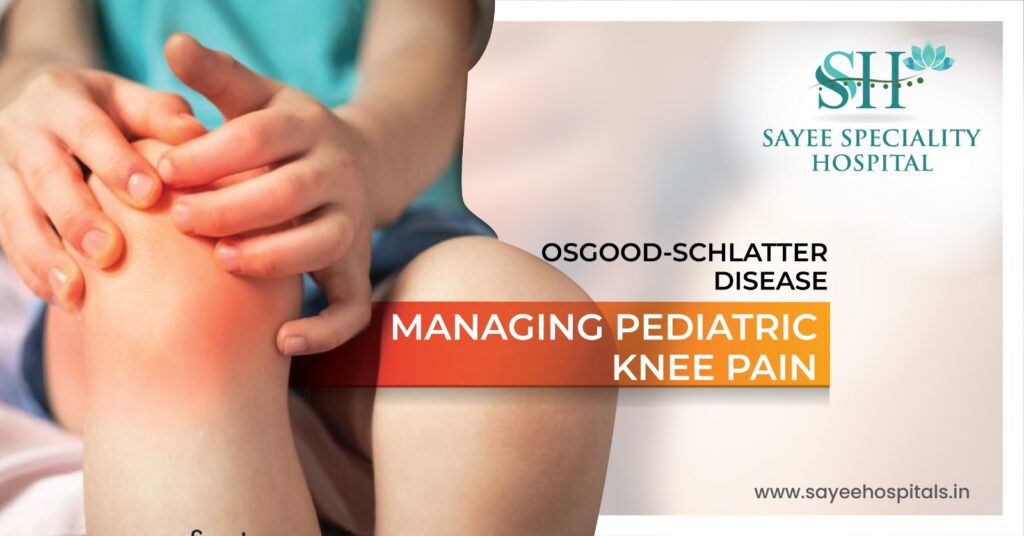
Osgood Schlatter Disease: Managing Pediatric Knee Pain
There’s a particular kind of frustration that comes with being a sporty twelve year old whose knee has decided it’s no longer cooperating. Practice hurts. Games hurt. Kneeling down to tie a shoelace hurts. And the adults around you keep saying “growing pains” in a tone that suggests you should just get on with it.
Sometimes, though, those growing pains have a specific name and a specific explanation, a specific management approach, and a genuinely good outcome at the end of it. Osgood-Schlatter disease is one of the most common causes of knee pain in active adolescents, and understanding what’s actually happening makes it considerably less alarming for both the young person experiencing it and the parents watching them limp off the pitch.
To understand Osgood Schlatter, you need to understand one specific piece of anatomy, the tibial tubercle. It’s the bony bump you can feel just below the kneecap at the top of the shin. This is where the patellar tendon attaches, the tendon that runs from the kneecap down to the shinbone and transmits the force of the quadriceps muscle every time the leg straightens or the knee extends.
In adults, that attachment site is solid, mature bone. In growing adolescents, it sits directly over a growth plate, a zone of actively developing cartilage that hasn’t yet hardened into bone. Growth plates are structurally weaker than mature bone, which is what makes them vulnerable.
During running, jumping, kicking, and pivoting, essentially the entire vocabulary of most youth sports, the quadriceps muscle contracts powerfully and repeatedly. That contraction pulls on the patellar tendon, which pulls on the tibial tubercle, which pulls on the growth plate underneath it. Do that thousands of times across a training season, and the growth plate gets irritated. The body responds with inflammation swelling, tenderness, and pain concentrated right at that tibial tubercle attachment point. Over time, in some cases, the repeated pulling causes small fragments of bone to form at the site, creating a visible bony prominence that can persist even after the condition resolves.
That whole process is Osgood-Schlatter disease. A repetitive stress injury at a structurally vulnerable point in a growing skeleton.
The peak window is roughly 11 to 14 years old, the years when growth spurts are most rapid and the mismatch between skeletal development and physical demand is most pronounced. During a growth spurt, bones lengthen faster than the surrounding soft tissues, tendons and muscles, can keep pace with. That relative tightness increases the tensile load on the patellar tendon attachment, which is exactly the wrong time to be training hard for a sport that involves a lot of jumping.
Boys have historically been more frequently affected than girls, though the gap has narrowed considerably as girls’ participation in high impact sports has increased. Basketball, football, volleyball, gymnastics, and athletics, anything involving repetitive explosive knee extension ,carry the highest association.
Both knees are affected simultaneously in roughly a quarter of cases, which can be particularly disruptive to activity. The dominant leg is typically more symptomatic even when both sides are involved.
The pain of Osgood Schlatter is fairly localised and consistent in character, which makes it one of the more recognisable adolescent knee conditions once you know what you’re looking for.
The primary symptom is pain and tenderness directly at the tibial tubercle, that bump just below the kneecap. It’s typically sharp during activity and a duller ache at rest. Pressing directly on the bump reproduces the pain reliably, which is part of how clinicians confirm the diagnosis on examination.
Kneeling is often particularly uncomfortable because it places direct pressure on the affected area.
The pattern follows activity closely. Symptoms intensify during and immediately after sports running, jumping, squatting and ease with rest. That activity rest relationship is a consistent feature and helps distinguish Osgood-Schlatter from other causes of adolescent knee pain.
In some children, the tibial tubercle becomes visibly enlarged, a bony protrusion that’s noticeable even when the leg is extended. This is the fragment of bone that forms in response to repeated pulling at the growth plate, and once it forms it tends to persist even after the pain has fully resolved.
Tightness in the quadriceps and hamstrings is commonly found alongside the pain partly as a consequence of the body’s protective guarding response around a painful joint, and partly because tight muscles increase the tensile load on the tendon attachment and contribute to the problem.
In most cases, the diagnosis is clinical the combination of the child’s age, the sport they play, the location and character of the pain, and the tenderness on palpation of the tibial tubercle is enough. No imaging required.
X-rays are occasionally ordered, primarily to rule out other causes of adolescent knee pain, like a stress fracture of the tibial tubercle or a bone tumour, both of which are rare but worth excluding when the presentation is atypical. X-ray can also visualise calcification or fragmentation at the tubercle in established cases, though this doesn’t change management.
The important differential to keep in mind is that not all anterior knee pain in adolescents is Osgood-Schlatter. Sinding-Larsen-Johansson syndrome, a similar apophysitis at the lower pole of the patella rather than the tibial tubercle, produces pain slightly higher up and is occasionally confused with it. Patellofemoral pain syndrome presents differently but overlaps in age group and activity association. A clinician with experience in paediatric musculoskeletal conditions will work through these distinctions.
Treatment is conservative in almost every case, and the core principle is straightforward: reduce the load on the irritated growth plate until it matures and the vulnerability resolves.
Relative rest is the starting point not complete cessation of all activity, which is both impractical and unnecessary, but a reduction in the high-impact activities driving the symptoms. Most clinicians recommend modifying rather than eliminating sport, finding the level of activity where symptoms are manageable rather than trying to push through significant pain. That threshold varies between children and needs to be assessed individually.
Ice applied to the tibial tubercle for 10 to 15 minutes after activity reduces local inflammation and provides symptomatic relief. It’s simple, inexpensive, and genuinely effective as a routine post-activity measure during the symptomatic period. NSAIDs like ibuprofen can be used short-term for flare management, though they shouldn’t become a way of masking pain to continue training at a level the knee isn’t tolerating.
Stretching the quadriceps and hamstrings is the rehabilitation cornerstone. Tight quadriceps increase the resting tension on the patellar tendon and amplify the pull on the tibial tubercle with every contraction, addressing that tightness directly reduces the mechanical stress driving the condition. Hamstring tightness alters knee mechanics in ways that compound the problem. A structured stretching programme, done consistently rather than occasionally, makes a real difference over weeks.
Strengthening exercises particularly targeting hip abductors and external rotators help correct the biomechanical patterns that overload the knee, and are increasingly included in comprehensive rehabilitation programmes rather than just stretching alone.
Knee straps or infrapatellar straps, worn during activity, apply counter-pressure to the patellar tendon and can reduce the force transmitted to the tibial tubercle attachment. Many young athletes find them helpful enough that they become a routine part of their kit during the symptomatic period.
Surgery is almost never necessary. The condition is self-limiting. Once the growth plate closes typically by mid to late adolescence the structural vulnerability that drives Osgood-Schlatter disappears with it.
Osgood-Schlatter resolves in the vast majority of cases once growth is complete. The pain goes. The activity restrictions lift. The young athlete returns to full sport without ongoing limitation.
The one lasting feature in some people is the bony prominence at the tibial tubercle the calcified fragment that formed during the active phase of the condition. For most adults who had Osgood Schlatter as teenagers, this bump is simply a physical reminder with no functional consequence.
Kneeling on hard surfaces can be uncomfortable in some cases, but significant ongoing pain is uncommon and surgery to remove the ossicle is rarely required and reserved for the minority with persistent symptoms into adulthood.
For the young athlete going through it right now and for the parents watching them navigate it the most important thing to hold onto is that this is temporary. The knee that’s causing problems at thirteen is not the knee that defines the next decade of sport. Managed sensibly, with appropriate rest and the right rehabilitation, Osgood-Schlatter is a detour, not a destination.
Recent Posts
Lower Back Pain Causes, Diagnosis, and Treatment Almost...
Strep Throat: Symptoms, Diagnosis, and Treatment Sore throats...

Understanding Menorrhagia: Causes, Diagnosis, and Treatment Most women...

Your Posture Is Destroying Your Spine Before 40...