
Lower Back Pain: Causes, Diagnosis, and Treatment
Lower Back Pain Causes, Diagnosis, and Treatment Almost...
Multispecialty Hospital in Padappai | Sayee Specialty Hospital
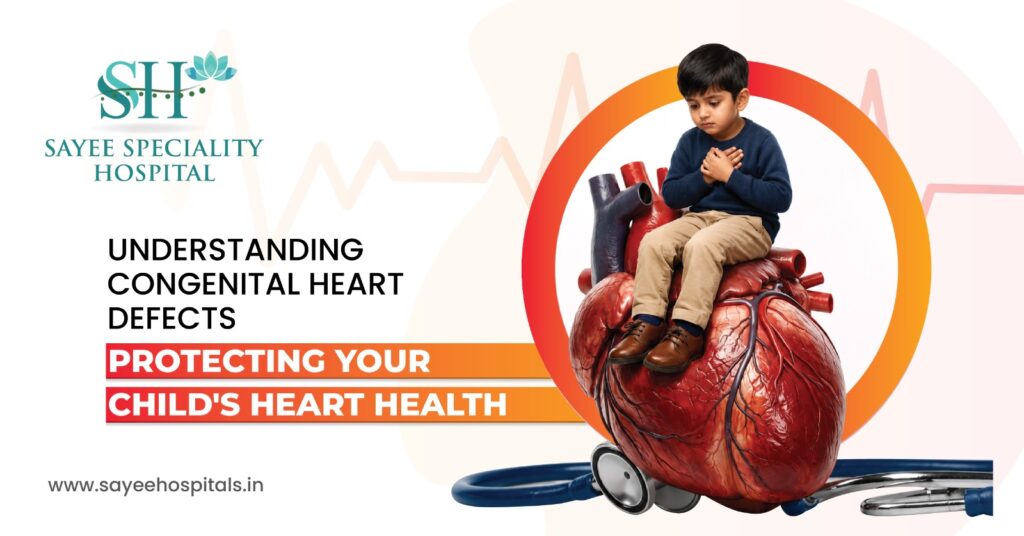
Understanding Congenital Heart Defects: Protecting Your Child's Heart Health
Finding out your child has a heart condition is one of those moments that reshapes everything. Whether it comes during a routine anomaly scan, in the hours after birth, or later in childhood when symptoms start to surface the words “congenital heart defect” land heavily, regardless of how they’re delivered. And the first thing most parents want to know, before anything else, is what it actually means for their child.
The answer varies enormously depending on the specific defect. Some are minor, self resolving, and require nothing more than monitoring. Others are complex, require surgery, and demand lifelong medical involvement. Understanding the landscape, what these conditions are, how they’re recognised, and what modern cardiac care actually offers, is the starting point for navigating all of it.
The heart begins forming in the first six weeks of pregnancy remarkably early, before most women even know they’re pregnant. It starts as a simple tube and goes through an elaborate developmental process, folding, dividing, and forming chambers, valves, and vessels. Congenital heart defects occur when some part of that process doesn’t complete correctly. The result is a structural abnormality that’s present from birth, ranging from a small hole between chambers to complex malformations involving multiple structures simultaneously.
CHDs are the most common type of birth defect globally, affecting roughly 1 in 100 births. That prevalence makes them far more common than most people realise and the spectrum of severity is wide enough that “congenital heart defect” as a category encompasses everything from conditions that close on their own in infancy to conditions requiring open heart surgery in the first days of life.
Broadly, congenital heart defects fall into a few structural categories, though individual conditions often involve more than one type of abnormality.
Septal defects holes in the walls dividing the heart’s chambers are among the most common. An atrial septal defect (ASD) is a hole between the two upper chambers. A ventricular septal defect (VSD) is a hole between the two lower chambers. Both allow oxygenated and deoxygenated blood to mix in ways that reduce the heart’s efficiency. Small VSDs frequently close on their own as the child grows. Larger defects in either category typically require intervention.
Valve abnormalities affect how blood moves between chambers or out into the major vessels. Stenosis, where a valve is too narrow to open fully forces the heart to work harder to push blood through the restricted opening. Valve regurgitation, where a valve fails to close properly and allows blood to leak backward, creates a different kind of inefficiency. Ebstein’s anomaly, which affects the tricuspid valve, is one example of a more complex valve malformation.
Complex conditions involve multiple structural abnormalities working together to significantly disrupt normal blood flow. Tetralogy of Fallot, one of the most well-known complex CHDs involves four simultaneous abnormalities, including a large VSD and pulmonary stenosis, that together cause significant oxygen desaturation. Hypoplastic left heart syndrome involves severe underdevelopment of the left side of the heart, requiring a series of staged surgeries in the first years of life.
Transposition of the great arteries, where the aorta and pulmonary artery are switched, is another serious condition requiring surgery shortly after birth.
Serious defects are often identified before birth during anomaly ultrasound scans, or detected shortly after delivery during newborn examination. But not all CHDs are obvious immediately, and some are picked up later in childhood.
In newborns and young infants, the signs worth knowing include cyanosis, a blue or grey tinge to the lips, skin, or fingernails indicating insufficient oxygen in the bloodstream. Rapid or laboured breathing, particularly at rest, is another significant indicator. Swelling around the eyes, abdomen, or legs suggests the heart isn’t circulating fluid efficiently. Poor feeding and inadequate weight gain where a baby tires quickly during feeds and takes in insufficient calories as a result, can indicate that the heart is working too hard to sustain normal activity.
In older children, symptoms shift. Fainting or near fainting during physical activity, tiring far more easily than peers, unexplained breathlessness, and swelling in the hands and feet during exertion are all presentations worth investigating. Some children with undiagnosed CHDs are identified during routine screening or incidentally on imaging done for another reason.
For the majority of congenital heart defects, no single identifiable cause is found. Most arise from a combination of genetic predisposition and environmental factors during early fetal development.
Several maternal health factors during pregnancy are associated with increased CHD risk. Rubella infection in the first trimester carries a well-established link to cardiac defects, which is precisely why rubella vaccination before pregnancy matters. Poorly controlled pre gestational diabetes increases the risk of several cardiac malformations. Certain medications taken during the first trimester — including lithium, isotretinoin, and some anticonvulsants, are associated with cardiac abnormalities and require careful risk-benefit discussion before and during pregnancy.
Smoking and alcohol during pregnancy both carry cardiac developmental risks alongside their broader fetal effects. Genetic conditions including Down syndrome (trisomy 21), Turner syndrome, and DiGeorge syndrome all carry significantly elevated rates of congenital heart abnormalities, which is why cardiac assessment is a standard part of the workup when these conditions are identified.
From a prevention standpoint, consistent prenatal care, folic acid supplementation from preconception onward, avoiding harmful substances, and ensuring vaccination status is current before pregnancy are all meaningful steps, not guarantees, but genuine risk reduction measures.
What treatment looks like depends entirely on the specific defect and its severity.
Some small defects particularly small VSDs and small ASDs are monitored rather than treated, with regular echocardiography tracking whether they’re closing spontaneously as the child grows. Many do, particularly in the first few years of life.
Catheter-based interventions have transformed the management of several defect types. Rather than open surgery, a thin tube is guided through blood vessels to the heart, where devices can be used to close holes or widen narrowed valves. These procedures carry significantly lower risk than open surgery and shorter recovery times.
Open heart surgery remains necessary for complex defects conditions like Tetralogy of Fallot, hypoplastic left heart syndrome, and transposition of the great arteries require surgical correction that catheter procedures can’t achieve. For some complex conditions, the surgical journey spans multiple procedures over the first several years of life rather than a single intervention.
The outcomes from paediatric cardiac surgery have improved dramatically over recent decades. Conditions that were once considered uniformly fatal now have high survival rates with appropriate surgical management, and the majority of children with CHDs grow into adulthood.
A treated congenital heart defect doesn’t always mean a resolved one. Many people who had cardiac surgery in childhood require ongoing cardiology follow-up into adult life, managed through specialist adult congenital heart disease clinics. Potential long-term complications include arrhythmias, heart failure, endocarditis risk, and in some cases the need for further intervention as the repaired structures age.
Dental health matters more than many families realise. Certain CHDs and surgical repairs increase the risk of infective endocarditis, a serious infection of the heart lining, following dental procedures that introduce bacteria into the bloodstream. Some children require antibiotic prophylaxis before dental work, and this is worth discussing explicitly with both the cardiologist and the dentist.
Developmental monitoring is also part of comprehensive CHD care, particularly for children who underwent surgery with cardiopulmonary bypass in infancy, where there is a known association with subtle neurodevelopmental differences in some children.
A CHD diagnosis changes the trajectory of parenthood in ways that are hard to fully articulate. The medical appointments, the monitoring, the surgeries, the watching, it’s a particular kind of sustained vigilance that doesn’t fully switch off.
What’s also true is that children with congenital heart defects grow up. They go to school, make friends, play sport, fall in love, have careers. The medical complexity of their early years doesn’t define the ceiling of what their lives become. Modern paediatric cardiology has made that possible in ways that simply weren’t true a generation ago.
Understanding your child’s specific condition, building a relationship with a specialist team you trust, and knowing what to watch for at each stage, that’s the most useful place to put your energy alongside everything else parenting asks of you.
Recent Posts
Lower Back Pain Causes, Diagnosis, and Treatment Almost...
Strep Throat: Symptoms, Diagnosis, and Treatment Sore throats...
Understanding Menorrhagia: Causes, Diagnosis, and Treatment Most women...

Your Posture Is Destroying Your Spine Before 40...